


This newsletter is for the parentified middle and younger siblings whose responsibilities as caretakers in their families have gone unseen.
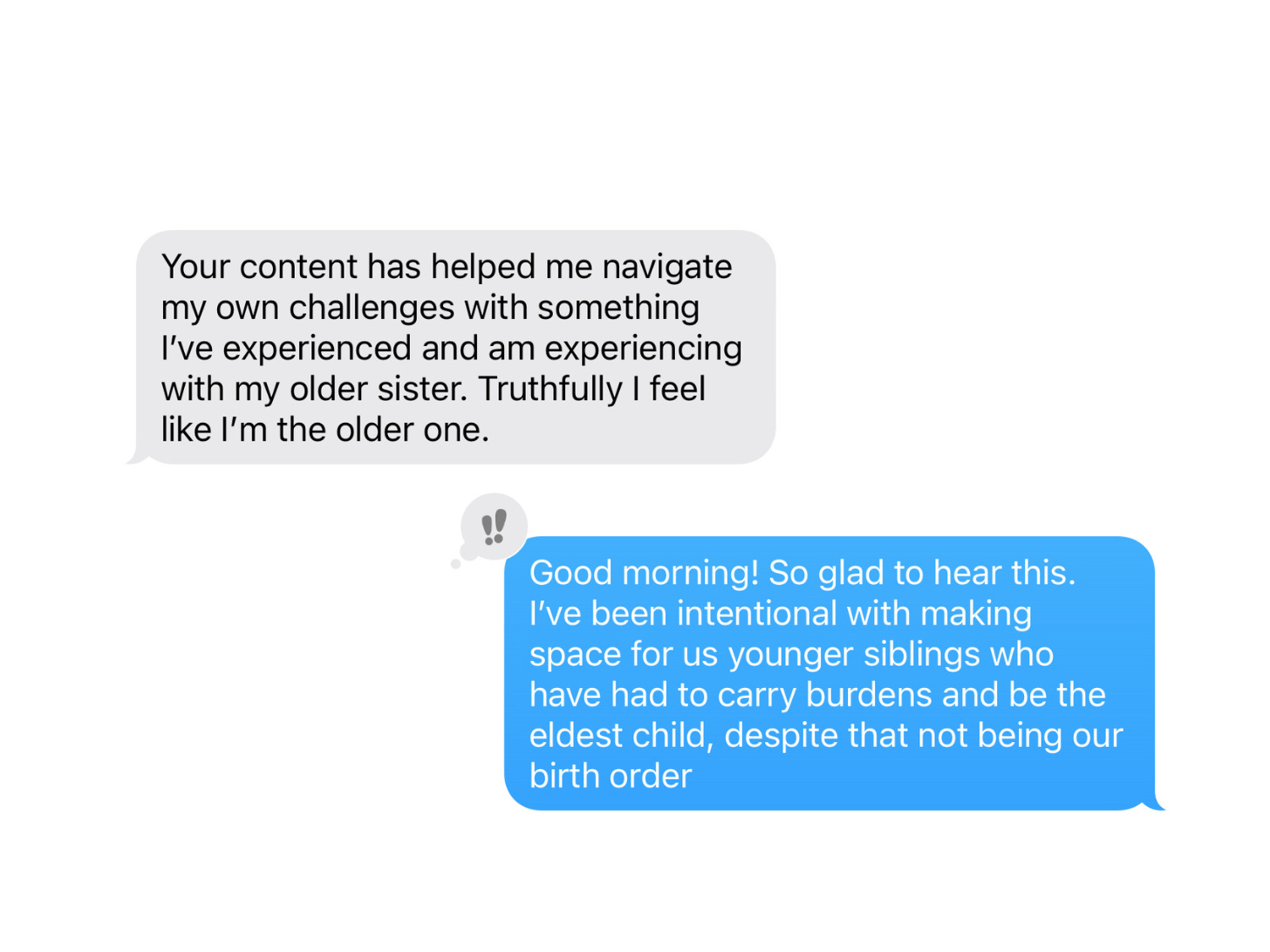
In my work as a therapist and from lived experience, the “eldest” doesn’t always mean firstborn. I am the youngest of 13 within a blended family. I am my mother’s second child and my father’s twelfth child. Growing up, even though my sister from my mother was just a few years older than me, I was expected to carry many responsibilities and was treated as if I were the eldest daughter, even though I wasn’t.
In my family, I became what I call the functional eldest child—the person, regardless of birth order, who ends up carrying the emotional, logistical, or parental weight of the family system. Sometimes this is the eldest daughter. Other times, it’s the middle or youngest sibling who steps into the role, or is forced into it, because circumstances demanded it – perhaps a parent was emotionally unavailable, a sibling was perceived as unreliable, or instability forced someone else to lead.
If you are not familiar with birth order theory, it was conceptualized by Alfred Adler, an Austrian psychoanalyst who believed that our position in the family influences our personality and worldview.
Birth order theory tells us that:
The eldest child often feels pressure to be competent, responsible, and dependable
The middle child typically strives for balance and may feel overlooked
The youngest child often seeks attention, freedom, or may be seen as the “baby” of the family and is often spoiled
But what matters more than actual birth order is our perceived role in the family. This is where the idea of psychological birth order comes in. Psychological birth order reflects how you function within your family system, not where you fall chronologically. That’s why the youngest child might become the caretaker, or a twin might feel like “the older one.” It’s about emotional hierarchy, not birth sequence.
Whenever people hear I’m the youngest, I am almost always greeted with sayings of how I must have been spoiled growing up or how I must have had a carefree childhood. These people form these perceptions about me simply because I am the lastborn, without even taking the time to ask me about my experiences or what it felt like to grow up. People also tend to assume that because I come from a very large family, I must have received princess treatment – without knowing that I grew up feeling like an only child.
These conversations show me that some people think birth order is fixed and parentification only happens to the eldest daughter, without realizing that middle and younger children can be:
expected to manage household responsibilities
relied upon to mediate family conflict or provide emotional support to siblings and parents
assigned caregiving duties for younger siblings or extended family members
pressured to succeed academically or professionally to restore family pride
viewed as more mature, capable, or dependable than their older siblings
expected to suppress their own needs to maintain family stability
Everyone has a unique role in their family system, shaped sometimes by birth order and sometimes by psychological factors. For example, you might be the eldest child who was parentified, but you might not realize that your younger siblings also experienced parentification–just in different ways. Instead of comparing our hardships, it’s more helpful to be curious about our siblings’ experiences, as no two children have identical childhoods—even within the same family. Don’t assume you know what a person went through based on their birth order, which can overlook their actual lived experiences.
Mindful Moment
Reflect on your experiences within your family system. Were you assigned as the functional eldest child in the home? How did this impact your sense of self and your sibling relationships?
An invitation
On November 15th, I’m hosting an in-person workshop in NYC on how to identify and reframe limiting thought patterns that are getting in the way of you reaching your goals.

Here’s a quick overview
📍 Location: Luminary, NYC
📅 Date & Time: November 15th, 2025 (11 am - 3 pm)
🎟️ Tickets: Early bird tickets are available until Oct 17th!
A big thank you to Luminary for being our venue sponsor. I’m looking forward to welcoming you into this space.
Connect With Me + Resources
I’m a therapist, the author of “Owning Our Struggles,” and the creator of The Siblinghood Theory. If you live in New York and are seeking a therapist, book a 15-minute consultation to learn more about my services. You can also follow me on Instagram for more mental health education. Here are other resources for you as well.
Take the relationship quiz: What’s Your Sibling Blueprint?
Listen to the latest episode of Mindful With Minaa